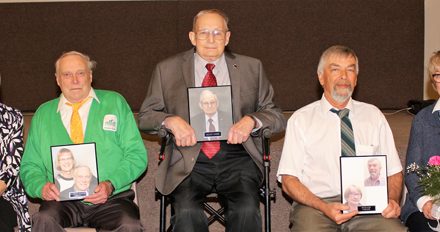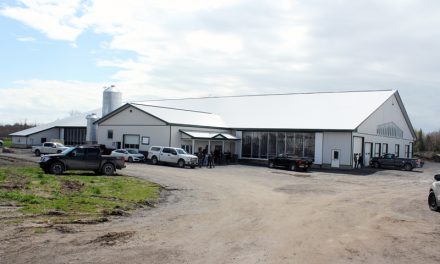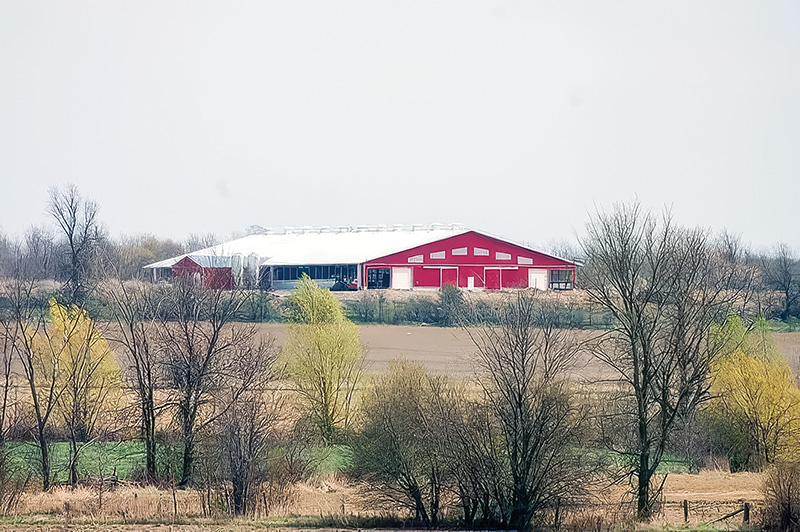
This image is a few years old now, but it shows how large and impressive the farm appears, even from a distance. Courtesy Photo
Owned and operated by Eldon and Betty Lindsay, Anne Lindsay and Jake Meeks
Special to the AgriNews
KARS – The history of a family farm is often measured in generations, with each one bringing its own challenges, opportunities and decisions that shape the future of the operation.
For Cranberry Creek Dairy Farms Ltd., outside Kars, faith, determination and a long-term vision have helped the Lindsay family navigate both family tragedy and the changing demands of modern agriculture while building a successful dairy operation.
The farm represents the sixth generation of Lindsay family farming, with its roots reaching back to the great-grandfather of current farmer Eldon Lindsay.
The first three generations – David, James and Donald Lindsay – supplied milk to the Kars Cheese Factory. Later, Donald Lindsay began shipping milk to Ottawa by train from Osgoode, marking an important step in the farm’s evolution and its connection to a larger market.
While the operation has changed considerably over the years, the Lindsay family is quick to point out that its success did not come from any single generation or expansion.
Instead, each generation built upon what had been established by those before it.
Every expansion, investment and change made by previous generations helped create the foundation for the operation that exists today. That sense of continuity remains an important part of the Lindsay family’s approach to farming – recognizing that they are not simply managing a farm but carrying forward a legacy that has been built over more than a century.
In 1955, at just 10 years of age, Eldon Lindsay was already working alongside his parents, Donald and Elsie Lindsay, on the family farm. Those early years provided him with a firsthand education in farming and the responsibilities that came with operating a dairy farm.
About a decade later, the Lindsay dairy operation had grown to a 30-kilogram milk quota, with approximately 25 Holstein cows being milked in a traditional tie-stall barn.
Holsteins have remained the breed of choice for the Lindsay family throughout the farm’s history. As Eldon became more involved in the operation, the farm eventually became known as DonEldon Farm, reflecting the partnership between father and son and another step in the continuing evolution of the family farm.
Eldon and Betty Lindsay’s married in 1972, and their children, Mark and Karen, grew up on the farm and became part of the daily rhythm of family farming at an early age. Mark worked alongside his father, milking cows before and after school, while Karen spent several years helping her grandfather feed the calves.
Behind the scenes, Betty played an equally important role in keeping the farm and family running smoothly. She was responsible for preparing meals for the hired help who lived on the farm and helping care for the hardworking family during those busy years.
By 1988, the Lindsay operation was ready for another significant change. The family expanded the dairy with the construction of a free-stall barn and moved from the traditional tie-stall system to a milking parlour. The new facility allowed them to milk approximately 80 cows twice a day.
The family’s passion for dairy cattle had become firmly established, and that enthusiasm was being passed from one generation to the next. With the expansion came another change in identity, as the farm became known as Lindsay Farms.
Dairy farming remained at the heart of the operation, but the family continued to diversify its agricultural activities through cash cropping and hay production. Over the years, additional milk quota was purchased, allowing the herd to continue growing. That expansion, which began with the earliest generations of the Lindsay family, has continued into the present day.
In 1998, Mark graduated from Kemptville College, then part of the University of Guelph, after completing the Dairy Cattle Management program. His education brought new knowledge and ideas to the family operation, including a renewed focus on herd improvement.
Mark began working toward having the herd classified as registered Holsteins, adding another dimension to the family’s longstanding interest in dairy cattle. As the operation continued to grow, additional farm buildings were constructed and farmland near Dalmeny was purchased, further expanding the foundation upon which the family’s modern dairy operation would be built.
Time continued to march on. Mark and Anne were married in 2004, and Karen and Perry married in 2007.
Mark Lindsay continued farming with his father, Eldon, as the family put a succession plan in place. In 2009, the two made another important decision, incorporating the operation.
There was, however, one small problem. The name Lindsay Farms was already being used by another farm in Lindsay, Ontario. The family would have to get creative.
With a small creek running alongside the farm in Kars, the solution soon became apparent. The operation was renamed Cranberry Creek Dairy Farms Ltd., a name that would come to represent the next chapter in the Lindsay family’s farming story.
Mark and his wife, Anne, also had a vision for the future: building and operating a robotic dairy barn. Before making such a significant investment, Mark wanted to understand the technology and determine what would work best for their operation.
In 2010 and 2011, he visited approximately 50 robotic dairy farms throughout Eastern Ontario and Western Quebec, studying different approaches and learning from farmers who had already made the transition to robotic milking.
His research ultimately led to the selection of two Lely Astronaut A4 robotic milking systems and a Lely Juno 150 automatic feed pusher. The new facility was a 130-by-274-foot, six-row, perimeter-feeding, 120-cow free-stall dairy barn, complete with a central management area.
In March 2012, Mark’s dream became a reality when the new robotic dairy barn opened its doors.
The transition required hard work and perseverance, but the cows adapted well to the new robotic milking system. For the Lindsay family, the new barn represented far more than a modern facility. It was another example of their willingness to embrace change while building on the foundation established by previous generations.
At the same time, plans were already underway to acquire and rent additional farmland, providing another avenue for the operation to continue expanding.
In November 2013, the Lindsay family experienced the kind of tragedy for which no family can ever truly prepare. Mark Lindsay, just 39 years old, was killed in a farming accident on the family farm.
Mark had one final chore to complete that evening and was moving equipment alongside the manure pit when the ground gave way. The telehandler he was operating overturned, trapping him inside. Despite his efforts to escape, Mark drowned in the cold water before he could free himself.
The loss was devastating to the Lindsay family and deeply felt throughout the farming community in Eastern Ontario. Friends, neighbours and fellow farmers quickly rallied around the family, offering practical help and support while also paying tribute to a young farmer who had contributed so much to the industry and his community.
For the Lindsay family, the months that followed were marked by profound grief, but also by a determination to keep the farm operating and preserve Mark’s legacy.
Eldon and Betty, along with Mark’s wife, Anne, made the decision to continue the operation. The robotic dairy barn was still relatively new, and Mark had only been able to see his vision in operation for about one year and eight months before his death.
Both Eldon and Anne came to realize that staying busy and taking each day as it came was one way of coping with the enormous loss. Their commitment to the farm gave them something to focus on while they continued to grieve.
Help also came from within the family. Eldon and Betty’s daughter, Karen, had a son, Jake Meeks, who had grown up around cattle and spent much of his youth working on the Lindsay family farm. Jake had also recently gained experience working with Lely robotic milking systems, making him a natural choice to join the operation during this difficult period.
Jake stepped into the roles of general manager and herdsman, while Eldon remained closely involved with the dairy, working in the barn every day and keeping a watchful eye on the operation.
Anne continued working off the farm at a local secondary school, supporting students with educational needs and behavioural concerns, while also handling the farm’s accounting, payroll and cash-crop marketing responsibilities.
With more than 200 cows and the crop operation to manage, Eldon, Anne and Jake quickly learned that teamwork would be essential to keeping Cranberry Creek Dairy Farms moving forward after Mark’s death.
Their combined efforts allowed the farm not only to survive, but to continue growing. In the years that followed, additional farmland that became available in the area was purchased, new farm buildings were constructed, and older facilities were upgraded.
Through an extraordinarily difficult chapter in the family’s history, the Lindsay family continued to build on the vision Mark had helped create, keeping his legacy alive through the farm he loved.
In 2015, Cranberry Creek Dairy Farms was inducted into the Purina Leaders Council for Excellence in the Ontario dairy industry, recognition of the family’s commitment to building a productive and sustainable herd.
The farm’s focus has remained consistent; raising sound, highly productive cows that are capable of remaining in the herd for many years. For the Lindsay family, longevity and cow health are as important as production.
Another of Mark’s plans came to fruition in 2016, when the roof of the dairy barn was leased to a company that installed solar panels to generate electricity for sale to the provincial grid.
The arrangement had been negotiated and signed by Mark before his death, but the family was unaware of the agreement until afterward. What initially came as an unexpected discovery ultimately proved to be a positive addition to the farm’s finances, providing another source of cash flow for the operation.
That same year brought another positive change to the family. Anne’s partner, Rob, moved in and became an important part of her life and the extended farming family.
In 2019, Jake and Beth were married, adding another milestone to the family’s story. A year later, in 2020, their son Ari was born, in the midst of a global pandemic.
While the years following Mark’s death had brought profound challenges, they also brought new people, new beginnings and reasons for the family to look toward the future.
The farm continued to grow, with additional milk quota eventually being purchased and the dairy operation continuing its gradual expansion. Through it all, Cranberry Creek Dairy Farms remained a family enterprise, shaped by the contributions of each generation and strengthened by the determination to keep moving forward.
By 2021, the dairy operation was continuing to grow, but Jake recognized that the two robotic milking systems were getting older and were carrying an increasing workload as the herd expanded.
Rather than invest in a third robot, the family and their team chose a different approach. A small parlour system was installed to provide additional flexibility, particularly for dry cows and fresh cows as they entered or returned to the milking herd.
The 10-stall parlour was designed by Jake in collaboration with Dundas Agri Systems. It allows 10 cows to be milked at a time, with three or more groups moving through the parlour twice each day.
The combination of the two Lely robotic milking systems and the smaller parlour have provided the farm with a flexible approach to managing its growing herd. Each system plays a role in the overall operation, helping to balance the workload while maintaining the focus on healthy, productive cows.
In May 2025, the Lindsay family took another important step in the succession plan that had begun years earlier. Jake Meeks was brought into the corporation as a shareholder, formally making him part of the ownership team at Cranberry Creek Dairy Farms.
Jake’s commitment to the herd has also been evident in his work to improve its genetics and future potential. He completed the farm’s first official herd classification, providing the family with valuable information to guide breeding decisions and improve the quality of future offspring.
The first 30 cows classified produced particularly encouraging results. One cow received an Excellent classification of 92 points, while the average score across the animals classified was 84 points.
For the Lindsay family, the classification represents more than numbers on a report. It is another investment in the future of the herd, and another indication that the farm’s focus on producing sound, productive cows that last is continuing into the next generation.
Today, Cranberry Creek Dairy Farms Ltd. is supported by four hardworking and dedicated employees who work closely with management as a team. The Lindsay family credits that teamwork and collaboration as an important part of the farm’s success.
The operation now includes approximately 800 acres of rotational corn and soybean crops, along with another 200 acres devoted to hay. The dairy herd has grown to between 125 and 135 milking cows, continuing the steady expansion that has characterized the farm for generations.
While farming remains at the centre of their lives, the Lindsay and Meeks families also place a strong emphasis on faith and giving back to the community.
Eldon and Betty remain actively involved in their local church. Anne volunteers with the Richmond Agricultural Society and recently joined the VIP Plowing Event Committee of the Ottawa Carleton Plowmen’s Association, helping with this year’s event and its fundraising efforts.
Her commitment to community fundraising has extended well beyond agriculture. In memory of her late husband, Mark, Anne has organized six legendary golf tournaments that together raised more than $80,000 for six different local charities.
As Eldon and Betty enter their golden years, the support of Anne, Rob, Jake and Karen, along with other family members, friends and neighbours, has become increasingly important. Farming remains deeply important to Eldon, who, at 81, can still be found working in the barn every day.
The family’s relationship with the community has always been reciprocal. Over the years, the Lindsays and Meeks have been there to help others in times of need, and the community has repeatedly returned that support. They describe the generosity of their neighbours and community as both a blessing and an important part of their ability to carry on.
The past decade has brought enormous transition to Cranberry Creek Dairy Farms. There has been loss, change, growth and the gradual passing of responsibility from one generation to the next. Through it all, the family has drawn on its faith, its passion for farming and the strength of those around them not simply to survive, but to continue building a successful operation.
Looking ahead, the focus remains on making the most of the farm’s existing robotic milking capacity, maintaining consistency in feed and crop production and ensuring the operation remains sustainable for whatever challenges the future may bring.
For a family that has farmed through six generations, the message is remarkably consistent: keep working together, adapt when necessary and never lose sight of the foundation on which the farm was built.
At Cranberry Creek Dairy Farms Ltd., the Lindsay family’s history has been defined by perseverance. And if the past is any indication, no obstacle is too great for this family and the farm they have worked so hard to preserve.
The Lindsay family is now looking forward to welcoming the agricultural community to its farm as host of the 2026 Ottawa Carleton Plowing Match.
The match will take place in a field on Second Line Road S., near Kars, directly across from the farm of the family’s longtime neighbour, Bill Tupper, at 6713 Second Line Road S.
The story of how the match came to Cranberry Creek Dairy Farms is almost as much about community and friendship as it is about farming.
Ironically, the first conversations about hosting the 2026 match took place at the visitation for Bill Tupper’s late wife, Georgie, at Tubman Funeral Homes. Both Bill and Georgie had devoted many years to volunteering with the Ottawa Carleton Plowmen’s Association.
At the visitation, the family’s paths crossed with Allen Hills, acting president of the Ottawa Carleton Plowmen’s Association. Hills and Jake and Beth Meeks had not seen one another for some time. Beth had previously helped Hills with landscaping and weeding his flower beds and gardens, following the death of his wife.
The reunion provided an opportunity to catch up, but another conversation soon planted the seed for something much larger.
Bill mentioned to Hills that Jake and Beth were his neighbouring farmers and that Cranberry Creek Dairy Farms might be a suitable location for the upcoming plowing match. From that simple conversation, the idea began to take shape, eventually leading to the decision to hold the 2026 event directly across the road from Bill’s farm.
For the Lindsay and Meeks families, there is something particularly fitting about the way it happened.
Georgie had dedicated years of her life to the Ottawa Carleton Plowmen’s Association and to her community. The fact that conversations about bringing the plowing match to Cranberry Creek Dairy Farms began at her visitation seems to have given the event an added meaning for those involved.
As the family looks forward to hosting farmers, competitors, volunteers and visitors on their farm, there is a feeling that Georgie may have had a hand in bringing it all together.
The family likes to believe that Georgie was working a little magic from above.