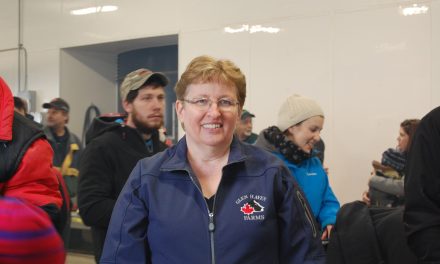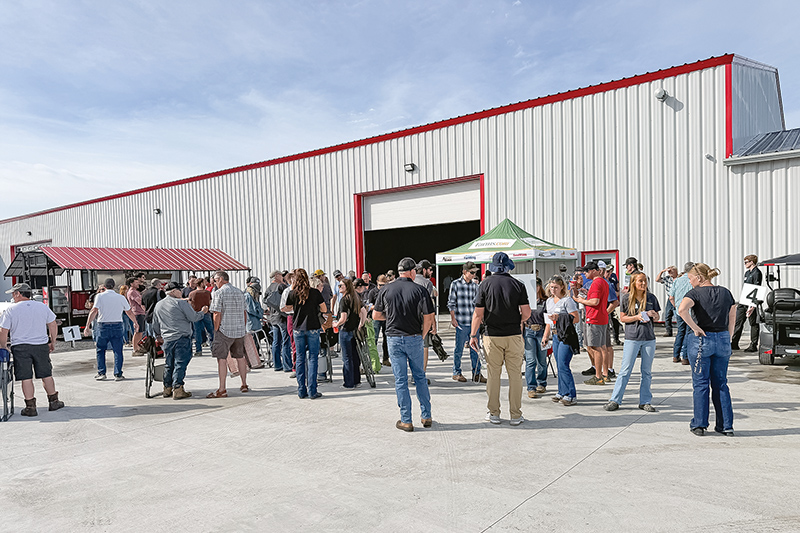
The Great Ontario Yield Tour always draws a large crowd, for the information it provides, the opportunities to network it offers, and at least in a small way the delicious bbq lunch that follows and the keynote speech that wraps things up. Tinkess Photo
MOOSE CREEK – One of the messages emerging from the 2026 Great Ontario Yield Tour, as farmers and industry representatives gathered at Domar Farms in Moose Creek was that what looks good from the road tell the whole story. The event, which took place on Aug. 20, enabled local farmers to hear what crop scouts and agronomists had found while travelling Ontario’s fields.
The 11th annual tour ran from Aug. 10 to Aug. 21, with crop scouts examining fields across the province and assessing corn and soybean yield potential. The tour focuses on measurements such as corn kernel counts and soybean pod counts, along with observations on crop development and growing conditions.
The Moose Creek gathering was one of two events held to present the tour’s findings. Moose Creek was the eastern Ontario event, while the western Ontario event took place Aug. 27 at Oxford Agropro in Hickson.
For eastern Ontario producers, the Moose Creek event provided an opportunity to put this year’s crop into perspective after a growing season that has generally provided adequate moisture and considerably better conditions than those experienced in many areas during the drought-like conditions of 2025.
The observations presented to attendees painted a generally positive picture for Ontario’s corn and soybean crops, although there are reasons not to become complacent.
Scouts encountered a range of challenges during their travels, including excess moisture, delayed planting, emergence problems, heat and concerns about weather during critical stages of crop development.
Reports included rootworm feeding on silks in Waterloo, white mould in Brant County, green snap following a windstorm and tip-back in some Chatham-Kent corn fields.
One observation perhaps summed up the value of actually walking the crop rather than judging it from the roadside.
Uneven emergence was noted in some fields, along with a significant number of 14- and 12-kernel corn counts. Soybeans, meanwhile, were showing strong vegetative growth and numerous pods in some areas as scouts moved east from Woodstock.
At Domar Farms, the program went beyond yield estimates.
The day’s special guest was Patrick Lynch, a certified crop adviser from Peterborough, who presented “Corn Production Past, Present and Future.” His presentation looked at how corn production has changed in Ontario, including the influence of genetics, fertility, weed management and modern technology, as well as where production practices may be headed.
Another major focus was precision management of fields.
Lynch presented on SWAT: Soil, Water and Topography, an approach that considers differences in soil fertility, plant population and crop management according to variations in topography and water availability.
For farmers accustomed to treating a field as a single management unit, that represents an important shift in thinking. Modern precision agriculture increasingly recognizes that a 100-acre field may contain numerous different growing environments, each with its own limitations and opportunities.
The educational demonstrations at Moose Creek also addressed several other issues facing producers.
Ceresco examined the growing demand for non-GMO soybeans and the production costs and market advantages and disadvantages associated with them.
Desjardins discussed investment management, wealth management and succession planning, while Hensall Co-op examined the potential for dry beans as an alternative crop.
Synagri focused on premium fertility products and nutrient management, while Taurus Ag examined fertilizer dissolution and nutrient release under its “Future of Fertility” presentation.
The combination of agronomy, marketing and financial management falls in line with the thinking that yield is only one part of the farm equation.
A high-yielding crop does not necessarily translate into the highest return if the cost of producing it is too high or if the market does not reward the additional production.
The connection between production and profitability was reinforced by a presentation on the 2026/27 Grain Market and Basis Outlook.
The eastern Ontario results of the yield tour were presented by Moe Agostino and Hicham Fram of Ceresco. An agronomist panel featuring Fram, Barry Cavanagh of Hensall Co-op and Pierre Guyennon of Synagri provided another opportunity to discuss what the scouts were seeing in Ontario fields.
Yield estimates are useful, but they are only one piece of the marketing puzzle. Production costs, grain prices, basis levels, storage opportunities and the broader supply-and-demand picture will ultimately determine how much of that yield ends up on the farm’s bottom line.
The 2026 tour also reflects changes taking place in Ontario agriculture.
Planting intentions projected increased soybean and corn acreage this year, with Ontario farmers indicating intentions to plant approximately 2.99 million acres of soybeans, up 3.6 per cent from 2025, and 6.412 million acres of corn, soybeans and all wheat combined, an increase of 1.9 per cent.
Those numbers provide context for the yield tour. Ontario farmers are making decisions about acres, inputs, genetics and management while dealing with increasingly variable weather and uncertain markets.
The 2026 growing season itself has been something of a study in contrasts. Ontario entered the season largely free of drought, following above-normal winter and spring precipitation. In eastern and central Ontario, soil moisture was generally considered adequate to surplus, although wet conditions delayed fieldwork in some areas.
Later weather conditions brought their own challenges. The result has been a crop that may look impressive in many locations but still requires careful examination before producers can confidently predict what will ultimately make it into the bin.
One lesson from the tour is that is essential to look beyond the numbers. Agriculture has become increasingly data-driven, but numbers only become useful when they help farmers make better decisions.
The yield tour provides another set of eyes on Ontario’s crops – thousands of observations gathered across different soil types, regions and production systems. For the farmer in Moose Creek, Winchester, or Lancaster, or anywhere else in Eastern Ontario, the provincial numbers will never replace walking their own fields, but they can provide context.
In a year when the crop has generally benefited from better moisture than last season, while farmers continue to face questions about weather, input costs and markets, having reliable information may be one of the most valuable tools available.
The crop may look good from the road, but the real question is what the numbers say when someone gets out of the truck and starts counting.