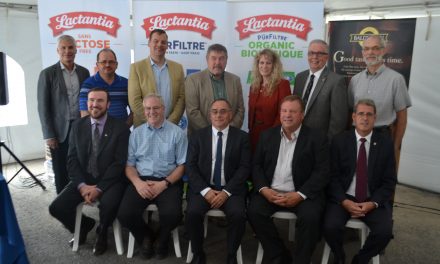
Following the grant announcement, the dignitaries present took a moment for a group photo. From left: SDG Warden Martin Lang, Stormont-Dundas-South Glengarry MPP Nolan Quinn, South Dundas Mayor Jason Broad, David J. Hendrick, Executive Vice President, David J Hendrick International Inc., Vic Fedeli, Minister of Economic Development, Job Creation and Trade, Shintaro Egusa, Katzuki Hori, South Dundas Deputy Mayor Marc St. Pierre. Tinkess Photo
MORRISBURG – The Province of Ontario has stepped in to help fund the development of Canada’s first non-GMO soymilk powder processing plant with a grant of $1.5 million to Alinova Canada Inc. through the Eastern Ontario Development Fund (EODF) of the Regional Development Program (RDP).
First launched in 2019, the RDP provides tailored supports to businesses and municipalities, helping them invest in the equipment, technologies and skilled workers they need to grow and remain competitive in a shifting economic landscape.
The facility is located in the former Homestead Organics building on Allison Ave. in Morrisburg, Ontario, and is expected to be operational by mid-March 2026.
The project, first announced in November 2024, was made possible by an investment of nearly $24 million by Alinova Canada Inc., a joint venture between DJ Hendrick International Inc. (DJHII) and Marusan Ai Co.
“In the face of economic uncertainty, it is vital that Eastern Ontario continues to protect and build our homegrown agri-food workforce,” said Nolan Quinn, MPP for Stormont -Dundas – South Glengarry in making the announcement on Tuesday morning, December 2. “Through the Regional Development Program, Morrisburg is proud to be home to Canada’s first soymilk powder processing plant, which will create good-paying jobs and strengthen our local economy for decades to come.”
Alinova Canada’s new facility will use Ontario-grown soybeans to produce over 1,200 metric tonnes of soymilk powder per year. This investment will not only solidify and expand Ontario’s domestic processing capacity but also strengthen the province’s competitive advantage as a leading global supplier of soybeans and soymilk powder ingredients.
MPP Quinn was accompanied by Vic Fedeli, Minister of Economic Development, Job Creation and Trade. “Alinova Canada’s investment is a vote of confidence in our province’s manufacturing capabilities and in our world-class workers,” said Minister Fedeli. “With their new Morrisburg facility, Alinova is onshoring key processing capacity from Japan for Ontario’s agri-food supply chain, creating good-paying jobs, and driving long-term economic growth in Eastern Ontario.”
“For the past 20 years, our company has enjoyed a strong relationship with the non-GMO soybean growers of Eastern Ontario,” said Nobuyoshi Sakai, President, Marusan Ai. “We are now embarking on a partnership designed to manufacture a made-in-Ontario soybean ingredient product that will meet the protein needs of the global consumer and leave a legacy of economic growth in the Morrisburg community.”
“As project leader and Board Director of Alinova Canada, I look forward to advancing the food processing sector in Eastern Ontario in partnership with Marusan Ai,” said David Hendrick, Executive Vice President, David J Hendrick International Inc. “Through this project, it is our full intention to ensure that Alinova Canada offers every opportunity possible to skilled workers and soy growers in the area as well as the Morrisburg community at large. We thank Minister Fedeli and the provincial government for their support and look forward to shining a light on this key industry.”
South Dundas Mayor Jason Broad spoke of the spin-off benefits that Alinova will have for the surrounding community. “Alinova Canada’s decision to invest in Morrisburg is tremendous news for the community,” said Mayor Broad. “With the support of provincial funding, this project brings new economic opportunities, high-quality jobs, and strengthens our position in Ontario’s agri-food sector. Not only will this facility export a made-in-Ontario product to global markets, but it will also create new opportunities for our local farmers and suppliers right here at home.
“We are super proud to welcome Alinova to South Dundas and appreciate the Ontario government’s continued investment in our region’s growth.”
At the end of the presentation, a Q and A session took place with the media in attendance. Mr. Hendrick was asked with the economic instability that’s affected the world since January of 2024, combined with the drought conditions that had occurred over the last summer, how at all has this affected this project?
So far, I’m going to say not that much,” said Hendrick. “And the main reason is we’re not in operation yet. And you know when we are in operation, even at that point, we’re very conservative in terms of the volumes of powder that we’re going to be talking about. So, for year one, we may do maybe 100 ton. Year two, we may jump up to, I don’t know, 500- 800 something like that. We want to get to 1,200 just to give you the order of magnitude. 1,200 ton of powder means it’s about two to one. So, 2500 ton of beans coming through here… not huge volumes, but you know, hopefully we’re going to ramp it up.
“In the short term, I’m going to say not so much, but I got to say, you hit the nail on the head, and Martin can probably comment and Nick (Thurler) as well. What I’m worried about right now, and I’m talking as a farmer. I’m not talking as the CEO or the Vice President of Alinova, but as a farmer, as a grower, in 2025 our beans were down. We had a half crop, 50 per cent down. Our corn crop was off by about 40 per cent and in 24 we were bloody lucky, because August opened up and we got the rain to finish the crop. But what I’m worried about, and I may be way off base, and again, Nick can make a comment, but I’m worried that the weather systems are changing. We rely on the St Lawrence weather system more than we do on the Ottawa River. And we’ve taken a couple of hits, and my eyes are open to see what happens in 26 (2026.)
“I think you’re bang on,” said Nick Thurler, local grower and dairy producer. “And we did (take a couple hits.) We had two years before that. And hopefully people put a little money aside, because there’s no money made this year in the farm. It’ll be a year that a lot of farmers will be collecting crop insurance, I think. I don’t know if we’re going to be there yet, but we’re on the borderline of it, so we’ll see.
“Hopefully, you know, things won’t cycle,” continued Thurler. “So, hopefully it’s only a couple of years where the summer was that dry and we’ll get back to something else. But we’re not… we don’t know. It’d be pretty sad, because this is the only thing I’ve known, is taking that risk every spring.”
Ontario is home to 59 per cent of Canada’s soybean production. As global demand for soybean products rise, the province is strengthening its agri-food sector through strategic investments, including through the onshoring of processing capacity.
Climate change and extreme weather conditions are a factor, but fortunately enough people believe there is a path through the difficult times that encourages them to try.