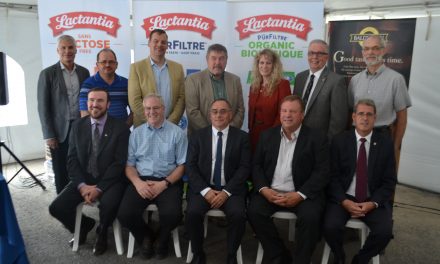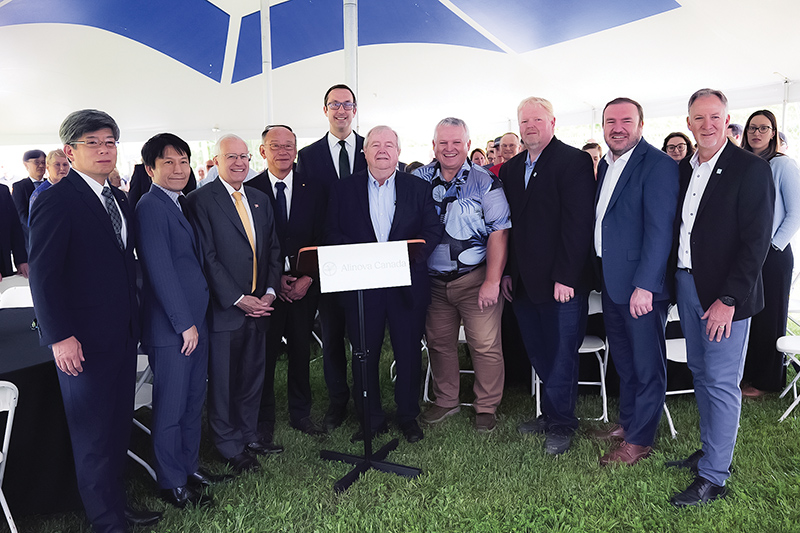
It was through the combined efforts of the people in this image that Morrisburg, and Alinova will lead the way in the production of high quality, non-GMO Soy that will find its way into food products for the global consumer. Tinkess Photo
MORRISBURG – With most major endeavours, a substantial amount of time passes between when an idea first forms and when it is finally brought to fruition. For Alinova Canada Inc., that time can be measured in years, but with the grand opening of the soybean processors new facility in Morrisburg, actual production is only weeks away.
David Hendrick, CEO of D J Hendrick International Inc. (DJHII), an agricultural and food-grade soybean company, acted as Master of Ceremonies for the formal grand opening of Alinova Canada Inc., the company in which he is partners with Japan’s Marusan Ai, that country’s second largest soymilk producer. Alinova will process locally grown non-GMO soybeans into a premium dry soymilk powder, which will be used for protein drinks, soup mixes, and creamers. The grand opening brought together approximately 100 people, partners, financial backers, political supporters and other dignitaries, to celebrate the efforts of those who made the venture possible.
Prior to turning the mic over to the invited guests, Hendrick answered the question that was probably on the mind of everyone present. “To answer probably the number one question from everybody, when are we going to start production? Let’s call it about mid-August, hopefully, end of August, latest. So that’s what we’re shooting for.”
The first guest to speak was Nobuyoshi Sakai, the Chairman and CEO of Marusan Ai. Speaking through an interpreter, Sakai spoke of the challenges in reaching this point.
“On behalf of Marusan Ai Company, Ltd. I’m truly delighted that we are able to celebrate this occasion in such a grand manner,” said Sakai. “There were, indeed, many challenges on the way to this day, from the initial planning stages to the construction itself. We faced numerous obstacles, both large and small.
“Each time, the ones who gave us the strength to move forward, Mr. David, Hendrick C.E.O. of Alinova, Canada, our joint partner, as well as other people here today. I extend my deepest gratitude to all of you for your dedication and passion.”
Sakai explained that Marusan Ai Company Ltd. was founded in 1952, and that they have been involved in the manufacturing and sale of food products made from soybeans. The major reason for their investment in Canada is a growing global concern that protein stocks will become more difficult to obtain in the future.
“However, I firmly believe that by sharing the same purpose and working together, Canada, and Japan, will be able to overcome any obstacle,” continued Sakai. “I know, too, I would like to make a promise to the community of Morrisburg. Alinova will continue to be a company brought up in this region, creating jobs and growing together with local agriculture. From this factory, we aim to take new steps forward to other worlds. We shall walk into the future together with all of you.”
Next to offer his remarks was Mr. Hideaki Ishii, Deputy Head of Mission of the Embassy of Japan in Canada. He spoke of the importance of soybeans as an indispensable part of the Japanese diet, and the result of this venture will help ensure the success of the food security strategy of both Canada and Japan.
“I am really pleased to know that Alinova, Canada is also fully aligned with the direction set out in Canada’s national food security strategy which was recently announced said Ishii. “I am very confident that Alinova, Canada, will stand as an excellent example of successful Canada, Japan collaboration in the Agrifood sector.”
Next to speak was Jill McAlister-Lane, executive vice-president, Public Affairs for Protein Industries Canada, an investor ($6.7 million) in this venture. “This is really an innovative product built on both Ontario’s high soy production and the growing world and a wider selection of protein options,” said McAlister-Lane. “We see great potential in it, both here in Canada and in countries like Japan. It’s a great example of Canada’s make it here opportunity.
“It’s time that we seize this opportunity, and so I’m so glad to see companies like Alinova and their partners helping to lead the way and doing so,” continued McAlister-Lane. “So, our utmost congratulations today to Alinova on the opening of your new facility and thank you for the work that you’re doing in our sector, and I just want to say for myself and everyone at Protein Industries Canada, we really look forward to continuing to see you succeed.”
Additional congratulations were next offered by Stormont-Dundas-Glengarry MP Eric Duncan, Stormont-Dundas-South Glengarry MPP Nolan Quinn, Vic Fedeli, the Ontario Minister of Economic Development, Job Creation and Trade, and South Dundas Mayor Jason Broad.
The dignitaries took a moment for photographs to commemorate the event, after which tours of the newly retrofitted facility were provided. Questions were freely answered, but photography inside the facility was prohibited due to the proprietary nature of the design. Here are a few details about the plant, which formerly was the home of Homestead Organics.
- The facility uses an automated Clean-in-Place system, to ensure the highest standard of hygiene and product integrity.
- The facility will process carefully selected food-grade, non-GMO soybeans. The soybeans are combined with water to create soymilk (no other ingredients are used). The resulting soy slurry is filtered to remove insoluble fibres, leaving a smooth and nutritious liquid.
- The separated fibre, known as okara is sent to a local farm where it is used in a biodigester to generate renewable energy and support sustainable agricultural practices
- The soy milk is heat treated to ensure food safety and to improve flavour and solubility. It is then transformed into powder through a unique process of spray drying where the liquid is atomized into small droplets and introduced into a stream of warm, filtered air, which evaporates the moisture almost immediately leaving fine particles of soymilk powder.
- Before packaging, lab testing of every lot is conducted to confirm food safety and product quality
- The food safety program was developed using Hazard Analysis Critical Control Point (HACCP) protocols
With Ontario being home to 59 per cent of Canada’s soybean production, Alinova should have a plentiful supply for the foreseeable future. It is an example of Canadians being more than just suppliers of raw materials. There is so much more we can do before our products enter the marketplace.
Early projections indicate that Alinova expects to produce 1,000 tonnes of soy powder per year by 2028.